

Keywords:
ship inspection report
cargo inspection report
marine inspection report
vessel inspection report
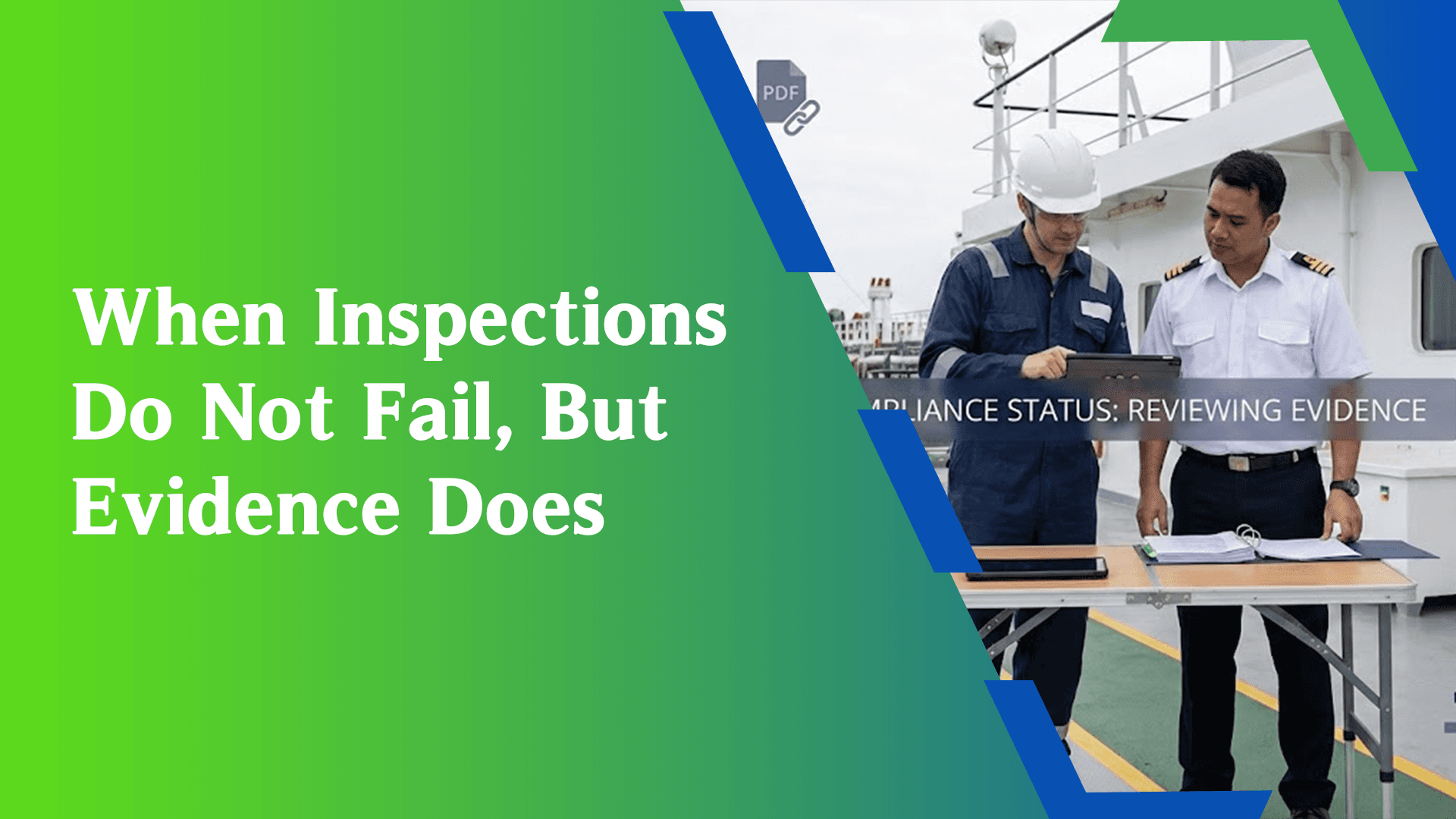
Most vessels do not fail inspections because they are poorly maintained.
They fail because the evidence of their condition is fragmented, inconsistent, or impossible to trust when it matters.
Before a charter, at on-hire, before a sale, or at the start of a new project, inspections are usually carried out properly. The vessel is attended. Checklists are completed. Photos are taken. Notes are written. On paper, everything looks acceptable.
The problem appears later.
Weeks or months after the inspection, a simple question is raised. What was the actual condition of this vessel at that moment? The answer should be straightforward. Instead, it often requires searching through emails, shared folders, personal phones, spreadsheets, and multiple report versions.
Photos lack context. Findings are written differently by different inspectors. Closure is marked, but proof is missing. Comparing today’s condition with a previous inspection, or with a sister vessel, becomes difficult or impossible.
This is where experienced teams lose time, confidence, and commercial leverage. Not because they lack competence, and not because the vessel is unsafe, but because inspection reporting was treated as a document rather than a verifiable and reusable evidence record.
In modern shipping, inspections are no longer just compliance activities. They are decision gates. Charter acceptance, hire and redelivery, project entry, upgrade planning, budget approval, and asset valuation all depend on whether inspection evidence can be trusted long after the inspection is finished.
This is where traditional inspection workflows begin to break down.
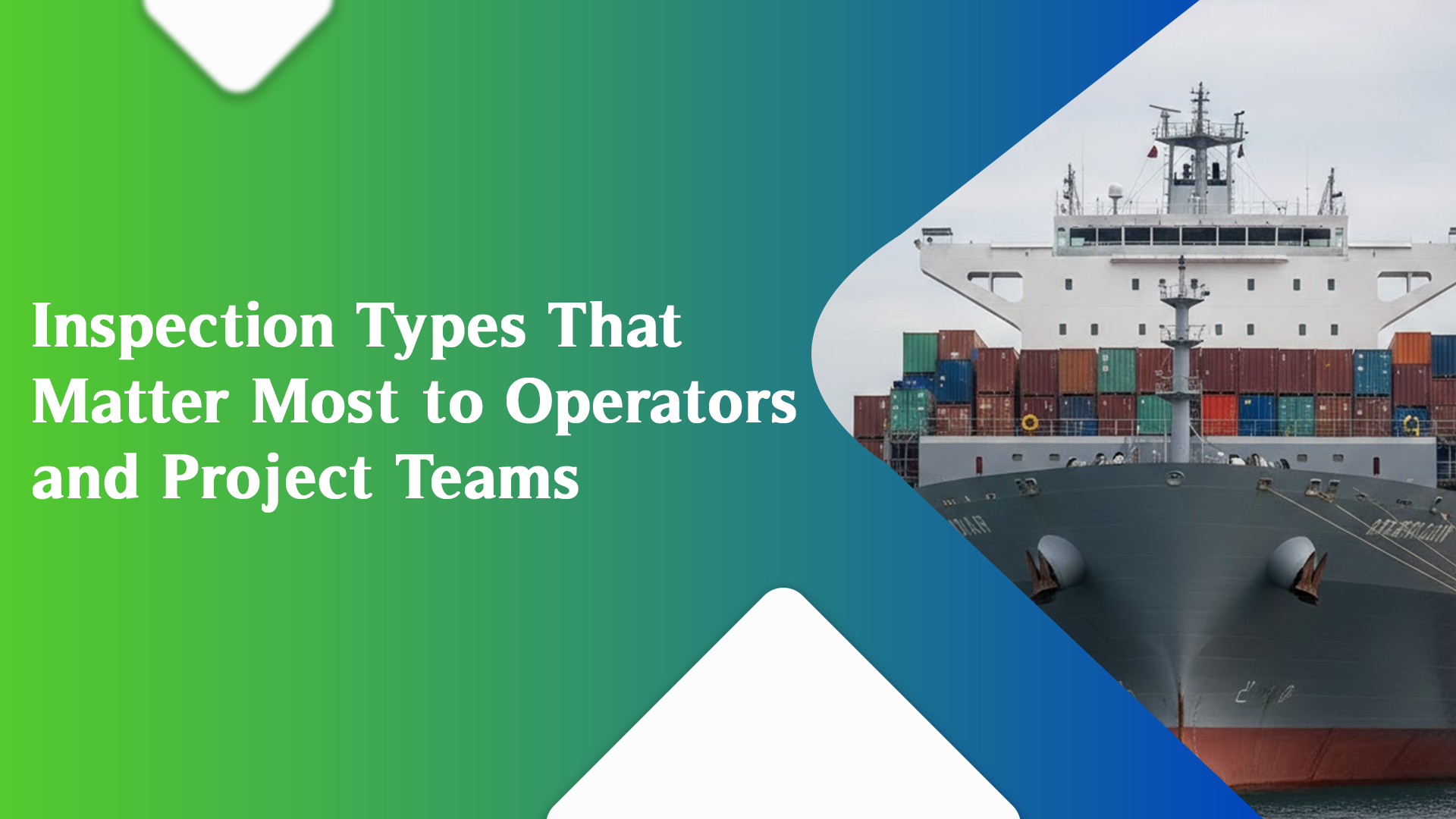
Statutory inspections such as PSC, Flag, and Class are well defined. Operators understand what is expected and how they are assessed. The real challenge lies in internal and operator-controlled inspections, where reporting discipline has the greatest impact on commercial and technical outcomes.
These inspections are used to assess whether a vessel is suitable for employment or investment. They are often the first formal snapshot of a ship’s condition for a new stakeholder.
What must be demonstrated is not only the current state of hull, machinery, deck equipment, automation, and certificates, but also credibility. Buyers and charterers want to see that findings are supported by clear, traceable evidence and that maintenance history is coherent.
A common failure is not the inspection itself, but the report. Statements such as “acceptable condition” or “appears satisfactory” provide no protection during negotiations. Photos exist, but they are not clearly linked to findings. Context is missing.
When evidence is weak, the vessel may still be accepted, but leverage is lost. Price adjustments, additional conditions, or delayed decisions often follow.
On-hire and off-hire inspections are among the most sensitive inspection moments. They define responsibility, condition, and financial exposure.
Disputes rarely arise because something was overlooked during the inspection. They arise because documentation cannot clearly demonstrate what was found, when it was found, and how it compared to a previous condition.
Missing timestamps, unclear photos, or incomplete inventories create room for disagreement. Reconstructing the inspection months later becomes an exercise in memory rather than evidence.
Clear, structured, and comparable reporting protects both parties and reduces friction.
Owner’s inspections and periodic condition inspections are intended to maintain control over the asset. They should provide management with a reliable understanding of vessel health over time.
In practice, these inspections often suffer from inconsistency. Different inspectors use different formats and language. Findings are subjective. Supporting documents are not always attached. Over time, reports accumulate, but insight does not.
Without standardization, it becomes difficult to identify trends, recurring issues, or gradual degradation. Decisions are then based on individual impressions rather than fleet-wide evidence.
Annual technical inspections and internal audits are critical for verifying ISM compliance, PMS execution, drill performance, and HSQE standards.
Many operators experience repeat deficiencies in these inspections, not because issues are ignored, but because follow-up is poorly documented. Corrective actions are raised, but closure evidence is incomplete or scattered. Responsibility is unclear. Lessons are not shared across the fleet.
The result is frustration on both ship and shore. The same findings reappear, and confidence in the inspection process erodes.
A strong inspection report is not defined by its length or by the number of checklist items completed. Its value lies in clarity, objectivity, and traceability.
A high-quality inspection report demonstrates:
What was inspected and why it matters
What was found, stated objectively and without interpretation
Clear photo evidence with timestamps and correct identification
Supporting documents such as certificates, log extracts, or service reports
Corrective actions with clear deadlines and responsibilities
Proof of closure that can be verified later
Contextual comments where needed to explain risk or impact
The ability to compare findings across time and across vessels
Most operators do not struggle because their vessels are in poor condition. They struggle because their reports do not allow others to independently verify what was found.
Across fleets and operators, the same issues appear repeatedly.
Templates are inconsistent or outdated. Photos are taken but not properly named or linked to findings. Corrective actions are tracked in spreadsheets that are disconnected from the inspection itself. Reports are shared through emails, messaging apps, or folders without version control.
Experienced inspectors rely on judgment and memory. Younger inspectors rely heavily on checklists but lack deep system knowledge, which limits verification depth. Both approaches fail when structure is weak.
Time pressure encourages shortcuts. Copy-paste becomes common. “Not applicable” is overused. Reports become long but shallow, making meaningful review difficult.
Most importantly, inspection data remains isolated. Reports sit in folders and are rarely analyzed. Patterns are missed. Lessons are not shared. Fleet-level visibility is lost.
The weaknesses in inspection reporting are not individual mistakes. They are structural.
Lack of standardization leads to different interpretations of the same requirement. Ambiguous language creates uncertainty. Evidence quality varies widely.
Traceability is weak. It is often unclear who recorded what, when changes were made, or how a finding was closed. Reconstructing inspection history becomes time-consuming and unreliable.
Administrative burden increases. Inspectors spend more time managing documents than inspecting equipment. Fatigue sets in, and reporting quality declines.
Without aggregation, inspections fail to generate insight. Repeat deficiencies go unnoticed. There is no baseline for comparison. Decision-making remains reactive.
Digital inspection platforms do not replace inspectors. They change how inspections are executed, recorded, and reused.
Standardized and guided inspections reduce ambiguity and interpretation. Inspectors are supported in what to verify and how to document it.
Evidence is captured with structure. Photos are timestamped, categorized, and linked directly to findings. Supporting documents are embedded rather than stored separately.
Corrective actions are created automatically, assigned clearly, and tracked until closure with proof. Nothing disappears into spreadsheets.
Fleet-level visibility becomes possible. Vessels can be compared. Trends can be identified. Management can see not only what was inspected, but what is improving and what is not.
Most importantly, inspection outputs become inspection history. Evidence is no longer static. It is reusable, defensible, and ready when needed for PSC, vetting, audits, chartering, or sale.
High-performing fleets treat inspection reporting as a discipline, not as paperwork.
They conduct structured internal inspections regularly. They enforce mandatory evidence standards. They review evidence quality, not just checklist completion.
Corrective actions are tracked with deadlines and accountability. Vessels are compared against each other. Officers are trained not only to inspect, but to document clearly and objectively.
When an inspection takes place, they already know what good looks like.
A strong inspection evidence package includes:
A completed and structured checklist
Clearly labeled, timestamped photo evidence
Supporting logs and certificates
A corrective action list with status and closure proof
A concise summary for management
Data that can be reused for audits, vetting, and commercial decisions
This is not about producing more documents. It is about producing evidence that stands on its own.
Inspection reporting is no longer a clerical task. It is a data integrity discipline.
Paper reports, spreadsheets, and unstructured photo folders cannot meet modern expectations. As regulatory scrutiny increases and commercial decisions become more data-driven, evidence quality will define outcomes.
Operators who master structured, evidence-driven inspection reporting will improve safety, reduce disputes, and strengthen commercial trust. Those who do not will continue to face repeated deficiencies, delays, and unnecessary exposure.
The future belongs to fleets that turn every inspection into a reliable and verifiable record of how a vessel is managed.
In 2026 and beyond, inspection reports are no longer static documents. They are living proof of asset management quality.
Whether preparing for PSC, chartering, audits, or internal decision-making, operators must be able to produce structured, verifiable inspection evidence at short notice.
Navirego helps fleets transform inspection reporting into a consistent, traceable, and fleet-level evidence system. Inspection history becomes an asset, not a risk.
[Explore how NAVIREGO] (https://www.navirego.com/contact) AI-native Inspection Ecosystem helps your team convert inspection reports into real-time insights, performance feedback, and predictive safety intelligence.
Feb 07, 2025 by Vivek Narain
Discover how AI in maritime is revolutionizing the shipping industry, enhancing efficiency, driving sustainability, and preparing businesses for the future.
Feb 20, 2025 by Vivek Narain
Explore AI's role in maritime—predictive maintenance, route optimization, autonomous vessels, and energy management—driving efficiency, safety, and sustainability.
Mar 10, 2025 by Vivek Narain
Improve your vessel’s CII rating by increasing deadweight capacity. A cost-effective, practical approach for shipowners to enhance fuel efficiency and compliance.

Mar 17, 2025 by Vivek Narain
Ensure your fleet complies with the new IP Code by July 2024. Learn key retrofitting steps, safety upgrades, and compliance solutions in this practical guide.
Mar 23, 2025 by Vivek Narain
Discover how AI and GenAI are revolutionizing maritime operations, enhancing efficiency, compliance, and decision-making for a smarter shipping industry.

Apr 02, 2025 by Vivek Narain
Explore AI regulations across the EU, U.S., and China. Learn about compliance, risk frameworks, and business impact in this comparative analysis.
Jun 03, 2025 by Vivek Narain
Ensure HKC ship recycling compliance by June 2025. Learn key rules, IHM certification, and how to align with EU SRR and authorized recycling facilities.
Jun 10, 2025 by Vivek Narain
Analyze 2024 Port State Control (PSC) reports across USCG, Paris, Tokyo, India, and Black Sea MOUs. Get data on detentions, top deficiencies, ship types, and compliance risks.

Jun 17, 2025 by Dario Barbaro
Explore how AI agents and agentic workflows differ, with real-world examples from shipping and offshore sectors. Learn their benefits, risks, and future potential.
Jul 30, 2025 by Dario Barbaro
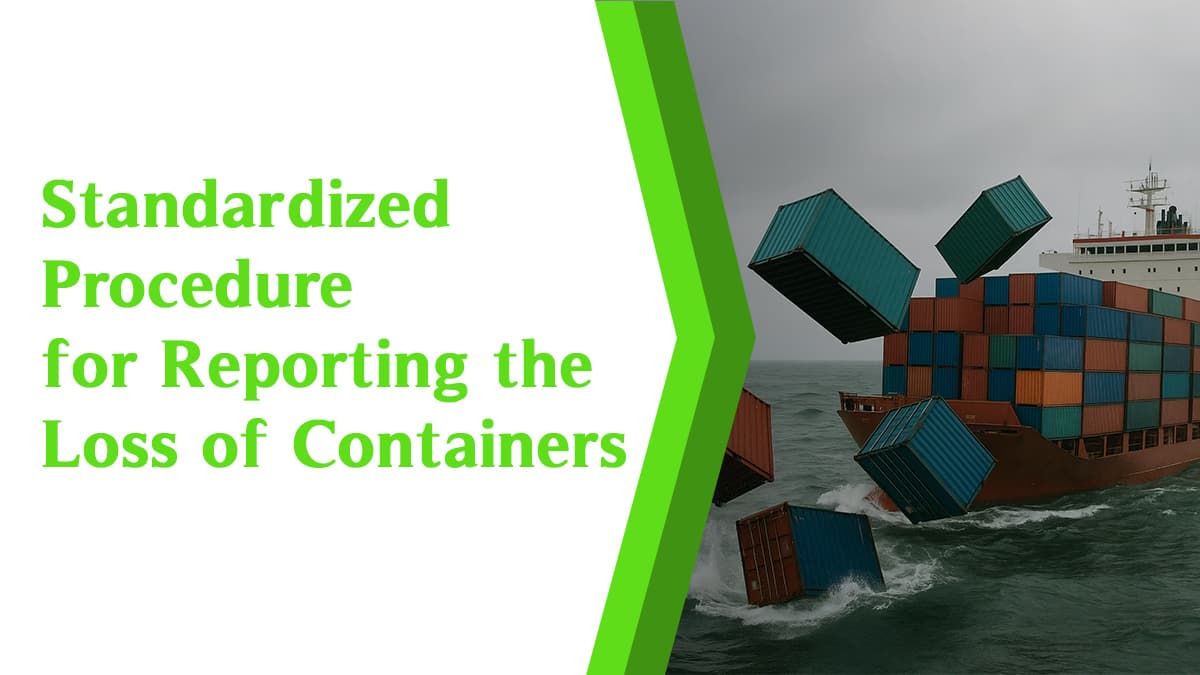
IMO RESOLUTION MSC.550(108) introduces mandatory, standardized reporting for containers lost at sea. Learn what it means for maritime compliance and safety.
Aug 06, 2025 by Dario Barbaro
Many maritime teams fall into the 80% trap, pushing AI toward full automation. Discover how Navirego’s augmented AI in maritime empowers professionals without replacing them.
Aug 18, 2025 by Dario Barbaro
Learn how to use Gen AI in high-stakes maritime operations without compromising safety, accuracy, or control. NAVIREGO shows the way.
Aug 27, 2025 by Dario Barbaro
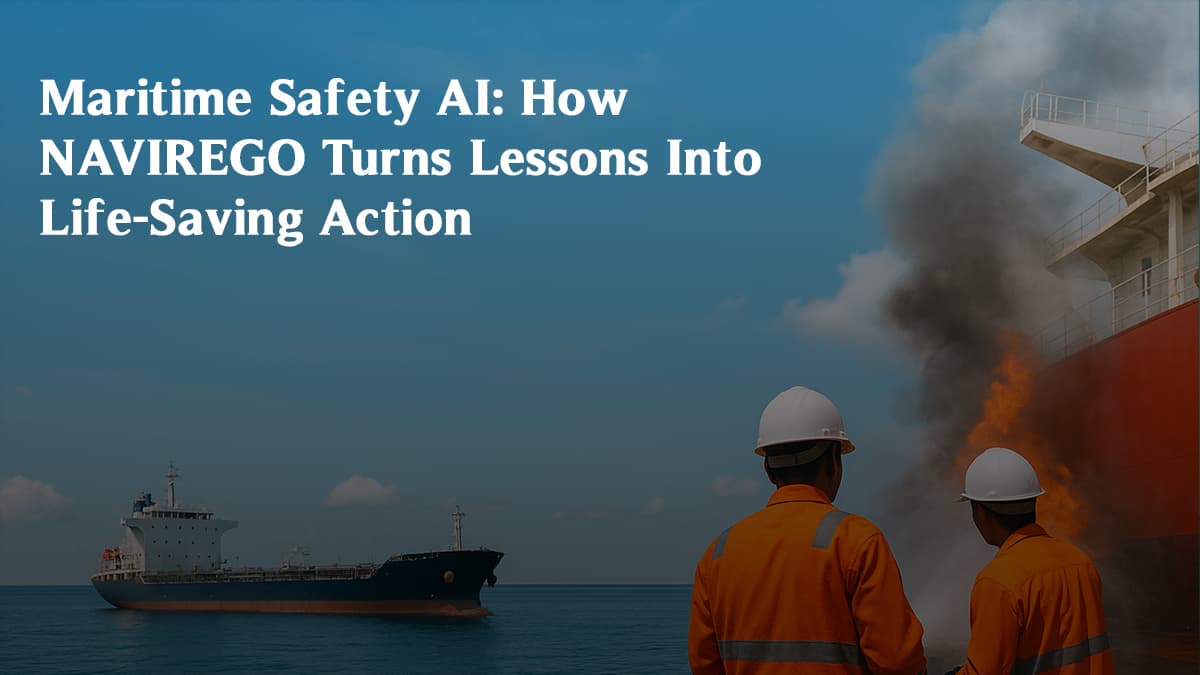
Maritime safety AI can help prevent future incidents by ensuring safety lessons turn into real-time updates and action. Learn how NAVIREGO is driving change.
Sept 08, 2025 by Dario Barbaro
IMO’s 2025 rules limit remote surveys, ISM audits, and ISPS checks. See how NAVIREGO helps fleets stay compliant in a hybrid compliance era.

Sept 09, 2025 by Dario Barbaro
IMO is adding VDES to SOLAS to counter AIS spoofing and improve secure ship-to-shore communication. Learn what this means for shipowners with NAVIREGO.
Sept 11, 2025 by Dario Barbaro
Generative AI in maritime works best with a vertical focus. See how NAVIREGO delivers domain-specific AI for HSQE, compliance, and operations.

Sept 22, 2025 by Dario Barbaro
Did you know LLMs like ChatGPT struggle with numbers? Learn why this matters for data-heavy maritime tasks and how NAVIREGO ensures precision.

Oct 25, 2025 by Dario Barbaro
Discover how AI-assisted regulatory search helps DPAs track rule changes, reduce manual checks, and stay audit-ready with NAVIREGO’s Standard Library.
Nov 21, 2025 by Dario Barbaro
See how NAVIREGO uses NLP and vision AI to extract insights from 1,000+ inspection reports, powering smarter, predictive maritime compliance.
Dec 30, 2025 by Dario Barbaro
Explore how maritime environmental regulations are evolving by 2026 and how technology and AI are reshaping compliance, inspections, and regulatory readiness.
Feb 23, 2026 by Dario Barbaro
Port State Control inspection trends for 2025—top detention drivers, PSC inspection report risks, and practical steps to avoid failures in 2026 readiness.
Mar 2, 2026 by Dario Barbaro
Explore how international maritime law and regional maritime laws and regulations differ in 2025/2026 across the EU, US, and Asia-Pacific.
May 7, 2026 by Dario Barbaro
** Explore PARIS MoU 2025 data on ship deficiencies and detention risks. Identify high-risk defects, trends, and strategies to avoid PSC detention.

REGD ADDRESS: MR-1, 5th Floor, WIng-A, AltF Statesman House, 148, Barakhamba Road,
Connaught Place, New Delhi - 110001
ADDRESS: Pawla Ponke 84-207 Bojano, Poland
TELEPHONE: +91 835 692 3342
EMAIL: info@navirego.com
About Us
Cognitive Hub
Terms & Conditions
Privacy policy


Home
Industries
Products
Case Studies
NEWSLETTER
Subscribe to our newsletter for regular updates and insights.